
Smoke damage restoration
We take on smoke damage in Miami homes and condos after a neighbor's fire, or a small fire that is already out, wherever its smoke reached.
When to call
- Smoke or soot reached your unit from a fire next door or another floor
- A small kitchen fire is out, but a film or smell spread through the home
- Soot on walls, ceilings or vents in rooms the fire never reached
- A smoke smell comes from the vents when the air conditioning runs
- You manage a building where several units or a corridor took smoke
What to do first when smoke has reached your home
If the building was evacuated, nobody goes back in until the fire department that fought the fire says so. FEMA’s Ready.gov tells you to check with the fire department that your home is safe to enter and not to reconnect utilities yourself: the fire department should make sure the utilities are safe to use or disconnected before it leaves. Inside the City of Miami that department is the City of Miami Department of Fire-Rescue; in unincorporated Miami-Dade and the 29 municipalities it serves, it is Miami-Dade Fire Rescue.
EPA’s wildfire indoor air guidance warns that cleanup can expose you to ash and other products of a fire that may irritate the eyes, nose or skin and cause coughing and other health effects.
Record the damage before anything is cleaned or thrown out. FEMA’s advice on recovering from a disaster is to contact your insurance agent first if you have insurance, and to take photos and make a list before you clean up; its home fire page adds that no damaged goods should be thrown away until that inventory is made. Food, medicine and the rest of the first day are on our page of first steps after a fire in Miami.
Where smoke goes in a building that did not burn
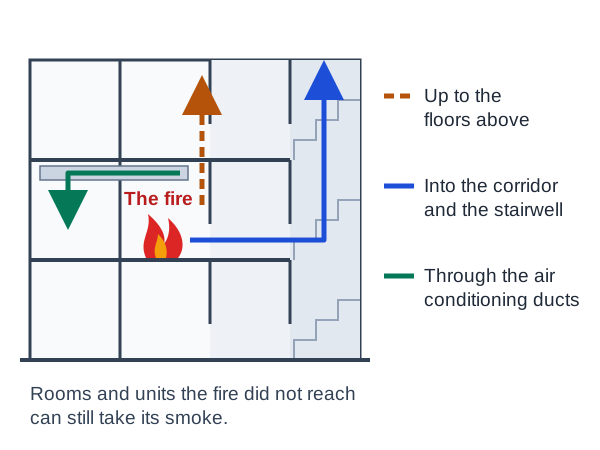
Smoke travels from the room that burned to rooms and homes the flames never reached: up to the floors above, into the corridors and stairwells, and through the air conditioning, the three routes the drawing above shows. The U.S. Fire Administration explains that fire and smoke tend to spread upward, because the heat of a fire rises, which puts the floors above at risk. It also tells residents of tall buildings to close stair and corridor doors so that smoke does not fill the stairwell or the corridor: the shared spaces are a route of their own. The third route is the air conditioning. The U.S. Fire Administration’s video on the dangers of smoke says smoke can travel through hallways, doors, ductwork, and cracks and openings in a building’s walls and floors. A 1993 NIST report on air-moving systems calls the fire hazards of heating, ventilating and air conditioning systems significant, and says protection is needed from the spread of fire and smoke from fires that start outside the system as well as inside it.
Visible soot is not where the job ends. The trade’s fire standard, ANSI/IICRC S700 (first edition, 2025), describes how to assess where fire residues and odors are present, how heavy they are and where they stop, in the building, in its systems such as the air conditioning, and in its contents. It covers fires inside the building, in an adjoining building or nearby, other than wildfires, so a neighbor’s fire is part of the job it describes.
The Census Bureau’s American Community Survey for 2020 to 2024 counts 48.8% of the City of Miami’s housing units in buildings of 20 or more units. In a building that size, smoke damage cleanup after a fire in one unit may take in the floors above it, the corridor and the stairwell.
What a smoke damage inspection covers
A residential smoke damage inspection follows the smoke from where it came in to where it stopped, and writes down what it reached: each room and its walls, ceilings, floors and fixtures; the air conditioning system; the belongings; and the places out of sight, such as closets and the insides of cabinets.
The written scope sorts what was found into three kinds of work: what can be cleaned, what has to be deodorized and what has to come out. Cleaning the residue is a job of its own, set out on our soot cleaning page, and so is the deodorizing, on our page about removing the smell of smoke.
The air conditioning needs its own look, because, as the U.S. Fire Administration says above, smoke can travel through ductwork. EPA’s wildfire ash guidance suggests professional help when the HVAC system is affected. We clean the ducts and the air handler after smoke with our own crew, as set out under duct and air handler cleaning. Before you run the system again, the Washington State Department of Health’s guidance for returning home after a fire says to check it before turning it on: make sure the fan is working, check for visible dust, and clean the area around the intakes. EPA’s ash guidance adds that if your HVAC system is safe to use, you can run it with a high-efficiency filter.
Smoke damage repair begins where cleaning stops. Material that holds smoke and cannot be cleaned has to come out, and replacing it is repair work. Miami-Dade County’s permit information says a building permit is required for repairs in unincorporated Miami-Dade, and that a city’s own Building Official handles permits inside its limits, which in the City of Miami means the City. The repair side is set out in our section on repairing a home after a fire.
In an older building, what gets disturbed matters as well. EPA tells homeowners to leave material that may contain asbestos alone and to let a trained, accredited professional sample it, and warns that lead-based paint is more likely in a home built before 1978.
Where a room or the whole building burned, the work is the full fire job of debris, firefighting water and drying, described in our fire damage cleanup section.
Smoke damage in a condo or an apartment
If your unit took smoke from someone else’s fire, tell the association or the building manager what you see before anyone starts work in the unit, read your declaration of condominium, and ask the manager whether cleaning inside the unit needs the association’s consent. If you rent, the Consumer Financial Protection Bureau’s guidance for disasters and emergencies says to notify your landlord in writing about the damage to your unit and to ask for an estimated timeframe for the repairs. If you manage the building, the inspection takes in the corridor, the stairwell and each unit the smoke reached.
Smoke damage after a small kitchen fire
A fire on the stove that is already out can still have sent smoke through the rest of the home. The kitchen is inspected with every other room the smoke reached, as above; the residue a stove fire leaves, and how it is cleaned, is set out under soot from a kitchen fire.
Have an electrician check an electric range, or any electrical appliance the fire heated, before it is used again. NIOSH’s guidance for wildfire cleanup workers says not to use electrical equipment exposed to heat from a fire until an electrician has checked it.
Can you stay in a home with smoke damage, and clean it yourself?
No agency we know of gives a rule on whether you may stay in a home that took smoke from a building fire but did not burn, or a level at which its air counts as safe: what the agencies address is going back in, as above, and who should keep out of the cleanup. EPA’s wildfire guidance on indoor air says children, older adults and people with heart or lung diseases such as asthma should not take part in cleanup work; its wildfire ash guidance adds pregnant women and says children should come back only after the affected areas have been cleaned up.
For anyone who cleans, the same wildfire ash guidance, which covers cleanup indoors, says to avoid dry sweeping and dusting, to mist surfaces to keep dust down, to use a HEPA vacuum if one is available, and to wear work gloves, long sleeves, goggles and a NIOSH Approved respirator marked N95 or P100. Such a respirator filters particles only: the Washington State Department of Health’s post-fire cleanup guidance says P100, N100 and N95 respirators will not protect you from gases and vapors, and that an N95 will not provide adequate protection from asbestos. EPA’s wildfire ash guidance also suggests professional help when the cleanup is more than you can manage on your own.
What smoke damage restoration costs, and how long it takes
No public body we know of publishes a price for smoke remediation in Miami. The national figures that are published are insurers’ average losses per claim and fire agencies’ estimates of fire loss, not prices for the work. What the work costs depends on how far the smoke reached and how much has to come out.
How long the work takes depends on how far the smoke reached: the rooms, units, air conditioning and belongings the written scope lists. Where replacing material needs a building permit (from the City of Miami inside the City, from Miami-Dade County in unincorporated areas), the permit adds time.
What a policy pays for is a question for your insurer, as our section on who to tell after a fire explains.
How the job goes
-
Step 1: Tracing the smoke
A restorer traces the smoke room by room, and into any shared spaces it reached, recording each surface and space it touched.
-
Step 2: The scope of work
The findings are written up as a scope of work, room by room, which the rest of the job follows.
-
Step 3: Surfaces the smoke reached
The crew cleans the soot and smoke film off the surfaces the scope lists.
-
Step 4: Rooms that hold the smell
The smell of smoke is treated in the rooms and belongings the scope lists.
-
Step 5: The air conditioning
The air handler and its ducts, looked at during the inspection, are dealt with as that assessment calls for.
-
Step 6: Belongings
Belongings the smoke reached are listed, then cleaned or set apart when cleaning will not save them.
-
Step 7: The final check
Before the job is called finished, the work is checked against the written scope.
Questions
Is smoke damage fixable?
Some of it. Which surfaces and belongings can be saved by cleaning and deodorizing, and which have to come out, is what the inspection described above sorts out, and nobody can say before the smoke has been traced.
What is the difference between fire damage and smoke damage?
Fire damage is what the flames burned. Smoke damage is the soot, film and smell a fire leaves, in the burned rooms and in rooms and units the flames never reached, sometimes on another floor. Smoke damage restoration is the work for the rooms and homes that took only the smoke.
Do you work on smoke damage from a neighbor's fire?
Yes. Smoke that came from a fire next door, on another floor or through the building's corridors is part of the smoke damage work we take in Miami, whether or not your own home burned.
Is smoke damage cleanup the same as soot removal?
No, it is wider. Smoke damage cleanup starts by finding where the smoke went and what each room needs; soot removal is cleaning the residue off, and odor removal is the deodorizing. We do all three, and the scope says which a home needs.
Had a fire? Call us.
Tell us what happened and where the building is. We will tell you on the call what happens next.
Open 24 hours, every day